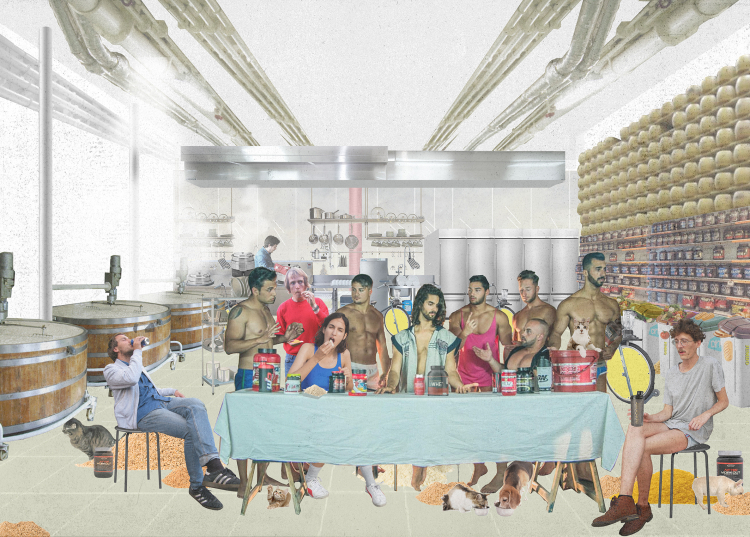
The human powered student building is self-sufficient in terms of energy use and produces no CO2. However, humans need extra food when they produce power, and producing this food also requires energy.
Assuming a typical Dutch diet, one kilowatt-hour of human generated electricity produces up to 30 times more greenhouse gases than one kilowatt-hour of grid electricity. How do we keep the human powered community carbon neutral?
***
Humans need energy — food — to survive. Moderately active adults require 2,000 to 2,200 Calories per day, which equals 2.4 kilowatt-hour of energy, or an average of 100 watts of power. Most of this energy (70-90 watts, depending on the person) is used to maintain basic functions such as breathing, digesting, pumping blood, regenerating cells and thinking. [1]
Daily activities typically increase power usage by 30%, which brings the total roughly to between 90 and 120 watts. [1] However, the students in the human powered community are more active than average people, because they generate power for several hours per day.
Students produce energy in their private rooms and on the communal power generating floors. They also need to climb stairs, pedal their washing machine, pump the water for their shower, and do the dishes.
If we assume a student to produce 100 watts of power for four hours per day (room energy use + work duties on the communal energy floors), how much extra food is needed?
How Much Food Do We Need?
The human body is not very efficient: the production of 100 watts of power requires 300 to 500 watts of energy in the form of food — similar to the conversion efficiency of a combustion engine. [1] This comes down to roughly 300 to 500 Calories per hour above the basal metabolism, or a total of 1,200 to 2,000 extra Calories for 4 hours.
For a daily intake of 2,000 to 2,200 Calories, the typical western diet (including more than 100g of meat per day) generates about 5 to 7 kg of CO2-equivalents per day. A vegetarian diet causes roughly 4 kg of CO2-equivalents, while a vegan diet produces the least greenhouse gas emissions, less than 3 kg of CO2-equivalents. [2] Note that these are averages: the energy use and greenhouse gas emissions depend on the ingredients and the location.
CO2-Emissions of Human Power
If a meat eater produces 100 watt of power for four hours per day, he or she would generate 2.5 to 5 kg extra CO2-emissions. On the other hand, if 400 watt-hour of electricity would be taken from the Dutch electricity grid, the CO2-emissions would be only 0.148 kg. That’s 16 to 32 times less. A switch to a vegan diet can lower the carbon emissions of human power to 1.5 to 3 kg, but this is still much higher (10 to 20 times) than the CO2-emissions of grid electricity.
However, because students generate their own power, they have a strong incentive to use less power than students in other buildings. Energy use in the human powered building is at least 10 to 20 times lower than in a common student building. In combination with a vegan diet, the CO2-emissions of human powered electricity would thus be similar to those of grid electricity.
The Dutch eat too much: they could produce power for 2 to 3 hours without extra food intake.
But many people in the Netherlands already consume much more than 2,000 Calories per day, even if they’re not generating energy. The average daily food intake in the Netherlands is 3,000 Calories, which means that the Dutch have a surplus of 1,000 Calories, sufficient for two to three hours of power production.
Some people do sports to burn this extra energy, while others don’t – obesity has become a major health issue in the Netherlands, just like in other industrialised societies. This ‘excess’ energy could be used to produce power without raising the CO2-emissions of food production.
Cheese, Protein Shakes, and Dumpster Food
To further limit the CO2-emissions of food, and because we are in the Netherlands, the students have opted to produce their own cheese. The waste product of that process — the whey — is used to make protein shakes.

Protein shakes, which are popular in health clubs, are convenient because they allow active people to ingest sufficient proteins without grilling steaks and steaming vegetables almost continuously. This saves time eating and cooking. Protein shakes are purely nutritional and are not to be confused with steroids.
Protein shakes allow active people to ingest sufficient proteins without grilling steaks and steaming vegetables almost continuously.
To add surprises to the diet, students on cooking duty go dumpster diving in the city, mainly at the big supermarkets. This can bring food on the table that has a large CO2-footprint, however rescuing it from the garbage is obviously a good thing.
The making of cheese and protein shakes requires thermal energy, which is supplied by the biogas power plant. This means that cheese and protein shake production happens on days that the kitchen — which depends on the biogas power plant for cooking — serves raw foods.
***
[1] “The Human-Powered Home: Choosing Muscles Over Motors
[2] Scarborough, Peter, et al. “Dietary greenhouse gas emissions of meat-eaters, fish-eaters, vegetarians and vegans in the UK.” Climatic change 125.2 (2014): 179-192. Abeliotis, Konstadinos, Vassiliki Costarelli, and Konstadinos Anagnostopoulos. “The effect of different types of diet on greenhouse gas emissions in Greece.” International Journal on Food System Dynamics 7.1 (2016): 36-49.


 Human Power Plant
Leave a reply to Sam A Cancel reply