The Human Power Plant is a working prototype of a muscular power generator, manned by a group of people. We cooperate with makers and sports coaches to build exercise machines that are suited for different types of human power sources, are fun and social to use, and produce a maximum amount of power.
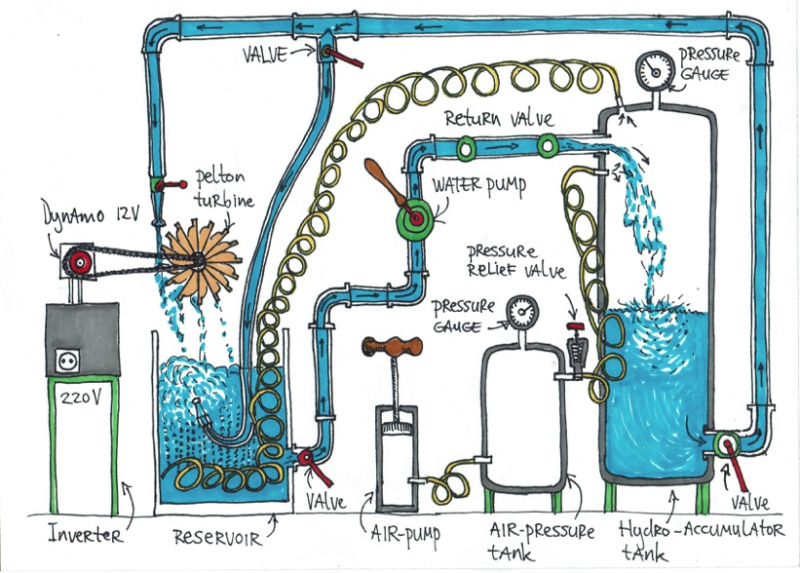
The Human Power Plant is an all-round off-the-grid solution. It can supply energy anywhere and anytime, provided that humans can be motivated to operate it. The power plant supplies energy in the form of electricity, water under pressure, and compressed air. It is built from simple and durable parts.
***
These days, we have automated and motorised even the smallest physical efforts. At the same time, we go to the gym to keep in shape, generating energy that’s wasted. The Human Power Plant restores the connection between physical exercise and energy use.
Hydraulic-Pneumatic System
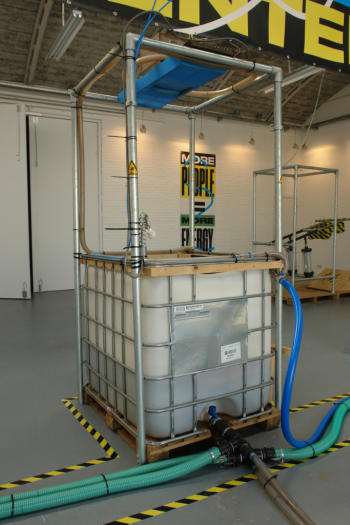
The human power plant consists of several exercise machines, which are set up around an energy storage and regulating device. Roughly half of the exercise machines are pumping water into a pressure vessel, while the other half are pumping air into a smaller tank.
The air from the smaller vessel then compresses the water in the larger one, increasing the energy potential of the hydro-pneumatic accumulator (small + large tank).
Image: The Human Power Plant in its second location, Deventer, the Netherlands.
Next, water under pressure is led to a Pelton wheel, which can supply mechanical energy or electricity (if coupled to a generator). The water falls from the water turbine into a receiving reservoir, from where it can be pumped into the accumulator again.
Human Powered Shower
The receiving reservoir of this closed water system is converted into a shower, where power producers can cool down and relax after their effort.
A Sustainable Battery
Water and air allow us to produce electricity without the use of chemical batteries and electronics — which are not sustainable components. In our muscular power generator, the hydro-pneumatic accumulator takes over the role of the battery and the voltage regulator.
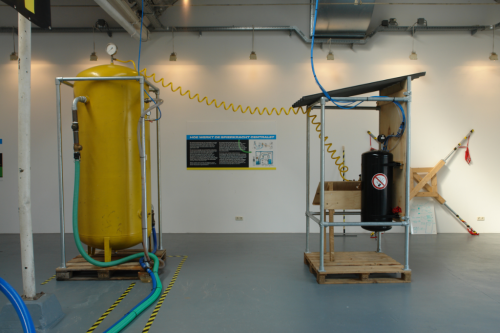
The human power plant is built from simple and mostly scavenged parts. The machine can be maintained and repaired by a plumber. Unlike chemical batteries, the human power plant can be operated for many decades.
Exercise Machines
Exercise machines for strength training can produce a lot of power in a very short time, making them an interesting addition to stationary cycling machines for human power generation. Having the choice allows people to choose which bodily advantages they gain from their efforts.

The human power plant is a work in progress. Each time the contraption is moved to another location, we improve, adapt or replace modules.
The exercise machines described below concern the set-up in Deventer, the Netherlands, where the human power plant 1.1 was exhibited in July/August 2017.
1. Reverse Hack Squat
The Reverse Hack Squat is aimed at strength training. A person stands with curved knees below the bar and stretches his or her legs. The exercise mainly builds leg muscles and strengthens the bones and the tendons.
This exercise machine converts human power into compressed air, which is used to pressurise water.
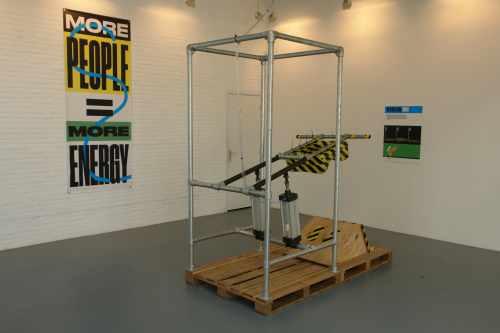

Our legs are roughly four times stronger than our arms, and this exercise machine is our most powerful producer of compressed air. The effort that’s required to lift the bar increases as the pressure vessel fills up.
2. The Cross Trainer
The Cross Trainer is the archetypal exercise machine, aimed at endurance training. The exercise strengthens the heart and the lungs.
Almost all the muscles are used, but the load on the body is the heaviest on the legs and the shoulders. The muscles of the torso are also used, especially for maintaining stability.

The arms push the levers forward and backward. This movement pumps water into the pressure vessel. The legs are moved up and down as if walking up the stairs. This movement is pumping air into the pressure vessel.
3. Biceps and Triceps Extension
This exercise machine, which produces compressed air, can be operated by four people simultaneously.
One person operates the foot pedals, which work similar to the foot pedals of the Cross Trainer that we described above. Two persons train their biceps and triceps by moving the handles on each side up and down.
A fourth person turns the wooden wheel that operates an air compressor. The manually operated air compressor is surprisingly effective.
4. Heavy Pull Drag
The Heavy Pull Drag produces a large amount of power in a short time. The machine is inspired by human drawn canal boats from earlier times. As an exercise device, it appeared in the 1990s, aimed at American football players.
To produce power, the operator puts on a harness with a cable attached to it. The cable is wound around an old car rim, which is fixed to a powerful membrane pump.
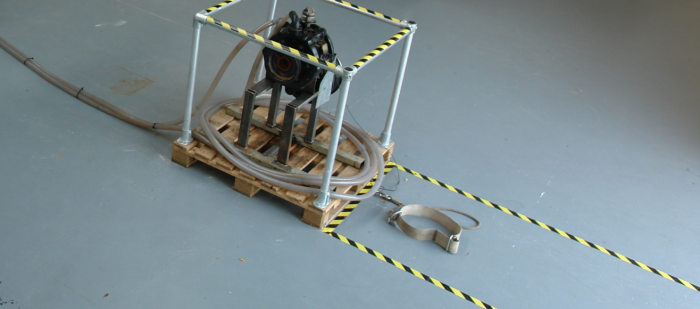
The operator walks forward or backward while wearing the harness, keeping his/her body as low to the ground as possible. Walking forward trains the muscles in the back, walking backward trains the quadriceps in the legs, and pulling sidewards trains the muscles of the hip.
The Heavy Pull Drag is our most powerful water pump.

Human Power Plant under re-construction in Antwerp, September 2017.
Where is the Human Power Plant?
- June 2017: Zero Footprint Campus, Utrecht, the Netherlands.
- July/August 2017: Kunstenlab, Deventer, the Netherlands.
- September 2017: Archipel, Antwerp, Belgium.
- October 2017 – January 2018: Museum Boijmans van Beuningen, Rotterdam, the Netherlands.
- …


 Human Power Plant
Leave a reply to kris de decker Cancel reply