
Exercise machines for strength training can produce a lot of power in a very short time, making them an interesting addition to stationary cycling machines for human power generation.
Exercise machines for strength training can produce a lot of power in a very short time, making them an interesting addition to stationary cycling machines for human power generation.
Human power is the most sustainable power source on Earth.

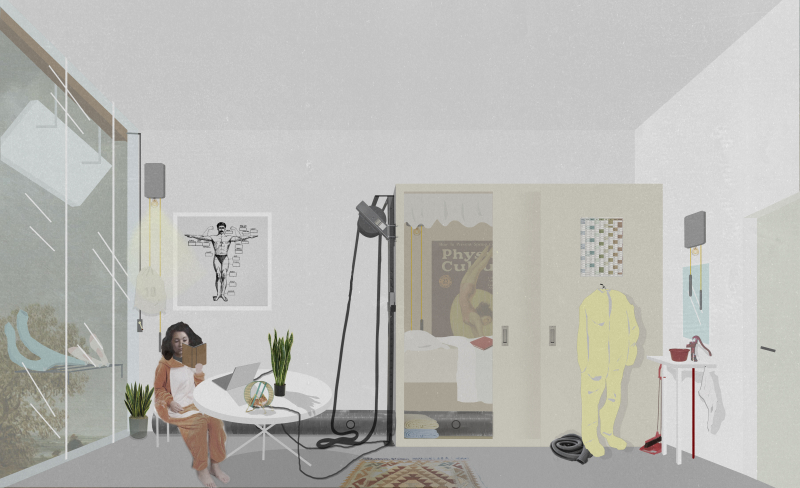
The human powered Van Unnik Student building can house 750 students in individual rooms, spread over 15 floors. The cheapest rooms are on the north side (no sun) and on the upper floors (there are no elevators in the building).
The Human Power Plant is an artistic research project into the possibilities of human power production in a modern society.
Unlike solar and wind energy, human power is always available, no matter the season or time of day. Unlike solar panels, wind turbines, and batteries, humans don’t need to be manufactured in a factory. Unlike all other power sources, human power increases as the human population grows. With a combination of low-tech solutions, lifestyle changes, and some exercise, the Human Power Plant demonstrates that a fossil fuel free life is possible.
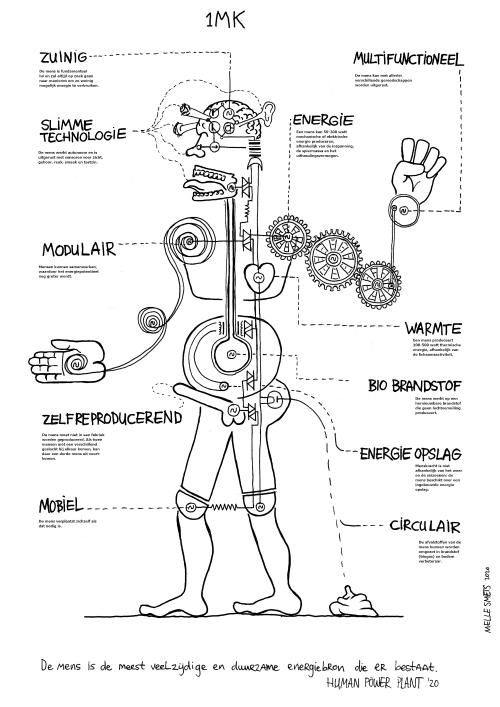 Throughout most of history, humans have been the most important source of mechanical energy. Building cities, digging canals, producing food, washing clothes, communication and transportation: it all happened with human muscle power as the main source of energy.
These days, human power plays virtually no role anymore. We have automated and motorised even the smallest physical efforts. Mechanical energy is now largely provided by fossil fuels, either as a primary fuel or converted to electricity.
This ‘progress’ comes at a price. Industrial society is totally dependent on a steady supply of fossil fuels and electricity, which makes it very vulnerable to supply interruptions. Furthermore, fossil fuels are not infinitely available and their large-scale use causes a host of other problems, such as climate change.
On the other hand, renewable energy sources such as wind and solar power are not always available, and their manufacturing is also dependent on fossil fuels. Meanwhile, in order to keep in shape and stay healthy, people go to the gym to exercise, generating energy that’s wasted.
The Human Power Plant aims to restore the connection between energy demand and energy supply. If we generate energy ourselves, we will first and foremost ask ourselves how much energy we actually need. This consideration is now largely missing in the debate about climate change and energy use, which is focused on technical solutions that make present ways of life non-negotiable.
Modern technology has greatly improved the potential of human power production. On the one hand, many electric devices have become very energy efficient. For example, solid state lighting consumes roughly ten times less power than old-fashioned light bulbs, so that a quick workout can supply many hours of light. On the other hand, we now have much better technology for human power production, ranging from sophisticated exercise machines to biogas power plants.
To find out if human power can sustain a modern lifestyle, we develop scenarios and prototypes on different locations in the Netherlands. The Human Power Plant is both a technical and a social challenge. A technical challenge, because there’s a lack of scientific and technological research into human power production. A social challenge, because unlike a wind turbine, a solar panel, or an oil barrel, a human needs to be motivated in order to produce energy.
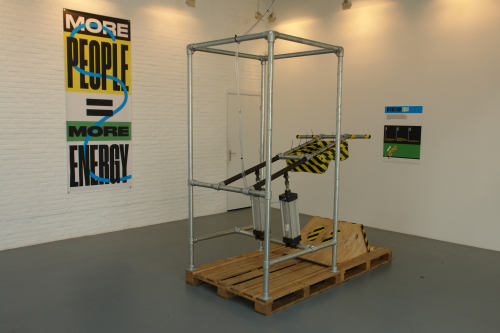
The Human Power Plant is a working prototype of a muscular power generator, manned by a group of people. We cooperated with makers and sports coaches to build exercise machines that are suited for different types of human power sources, are fun and social to use, and produce a maximum amount of power.
The Human Power Plant is an all-round off-the-grid solution. It can supply energy anywhere and anytime, provided that humans can be motivated to operate it. The power plant supplies energy in the form of electricity, water under pressure, and compressed air. It is built from simple and durable parts.
***
These days, we have automated and motorised even the smallest physical efforts. At the same time, in order to keep in shape and stay healthy, we go to the gym to workout, generating energy that’s wasted. The Human Power Plant restores the connection between physical exercise and energy use.
During the research phase, we followed a fitness programme to become better human power sources. This was a very instructive experience. One of the first things we learned is that there are important differences between individuals.
Melle, the powerhouse in our team, could lift a heavier weight on almost any machine. Kris, on the other hand, appeared to have better endurance, and could beat Melle with triceps and shoulder exercises. Such differences should be taken into account in order to achieve optimal energy production – there is no ready-made solution.
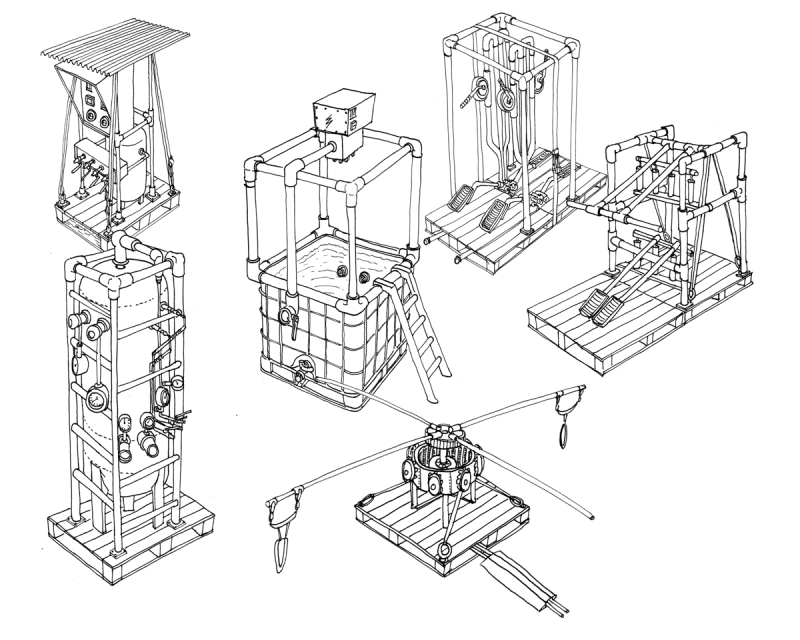
We also discovered that exercise machines for strength training can produce a lot of power in a very short time, making them an interesting addition to stationary cycling machines for human power production. Because most of them work on the basis of lifting weights, their power potential can be calculated.
Another thing we learned is that gyms are pretty boring places. The fitness equipment is positioned in such a way that people look in the same direction, which excludes all communication. And, while a stationary bicycle is considered to be the most energy-efficient human power machine, we discovered that stationary cycling is no fun.
For the design of our Human Power Plant, we wanted to address these issues.
Hydraulic-Pneumatic System
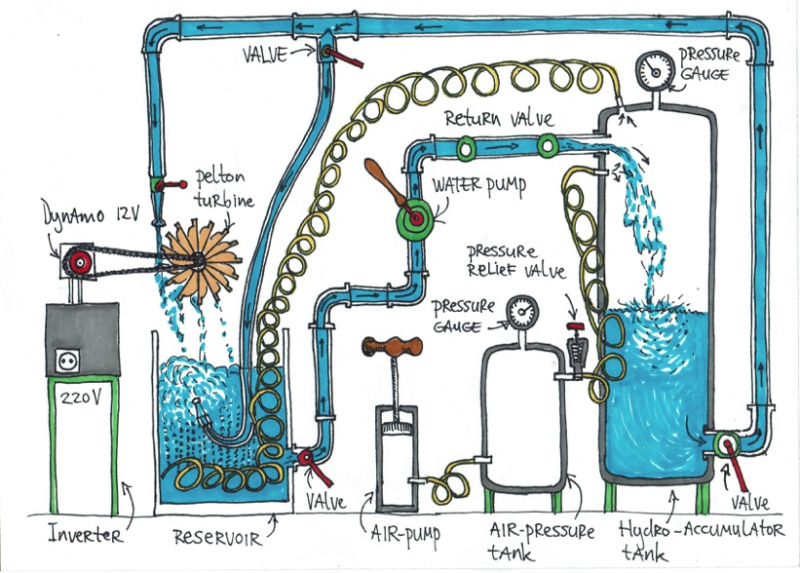
The human power plant consists of several exercise machines, which are set up around an energy storage and regulating device. Roughly half of the exercise machines are pumping water into a pressure vessel, while the other half are pumping air into a smaller tank.

The air from the smaller vessel then compresses the water in the larger one, increasing the energy potential of the hydro-pneumatic accumulator (small + large tank).
Next, water under pressure is led to a Pelton wheel, which can supply mechanical energy or electricity (if coupled to a generator). The water falls from the water turbine into a receiving reservoir, from where it can be pumped into the accumulator again.
Human Powered Jacuzzi
The receiving reservoir of this closed water system is converted into a shower/jacuzzi, where power producers can cool down and relax after their effort.
The electricity produced by the Pelton turbine can be used to heat the water of the jacuzzi, while compressed air can generate bubbles and water under pressure can produce water jets.

A Sustainable Battery
We opted for water under pressure and compressed air for several reasons. First, we want to make energy more visible and audible. Electricity is used all around us, but these energy flows are quiet and invisible. If we want to focus on energy, we first need to be aware of it.
Second, water and air allow us to produce electricity without the use of chemical batteries and electronics — which are not sustainable components. In our muscular power generator, the hydro-pneumatic accumulator takes over the role of the battery and the voltage regulator.
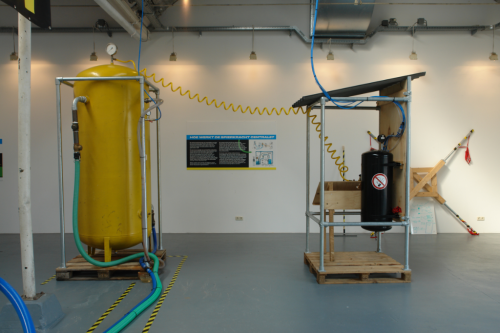
In this way, small variations in human power production can be smoothed out, keeping the voltage constant. Longer term energy storage is supplied by the humans themselves. Unlike solar and wind energy, human power is always available.
The human power plant is built from simple and mostly scavenged parts. The machine can be maintained and repaired by a plumber. Unlike chemical batteries, which need to be replaced every few years, the human power plant can be operated for decades.
The human power plant is a work in progress. Each time the contraption is moved to another location, we improve, adapt or replace exercise machines.
Human Power Plant 1.1: Exercise Machines
The machines described below concern the set-up in Deventer, the Netherlands, where the human power plant was exhibited in July/August 2017
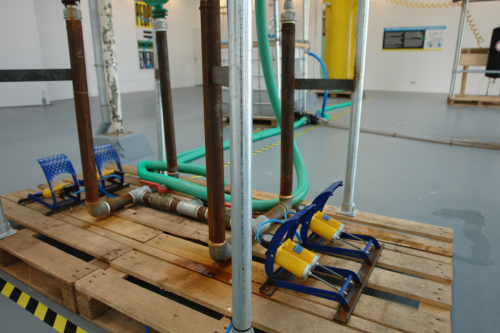
1. Reverse Hack Squat
The Reverse Hack Squat is aimed at strength training. A person stands with curved knees below the bar and stretches his or her legs. The exercise mainly builds leg muscles and strengthens the bones and the tendons.
This exercise machine converts human power into compressed air, which is used to pressurise water. The machine also produces a wonderful sound.
Our legs are roughly four times stronger than our arms, and this exercise machine is our most powerful producer of compressed air. The effort that’s required to lift the bar increases as the pressure vessel fills up.
2. The Cross Trainer
The Cross Trainer is the archetypal exercise machine, aimed at endurance training. The exercise strengthens the heart and the lungs.
Almost all the muscles are used, but the load on the body is the heaviest on the legs and the shoulders. The muscles of the torso are also used, especially for maintaining stability.
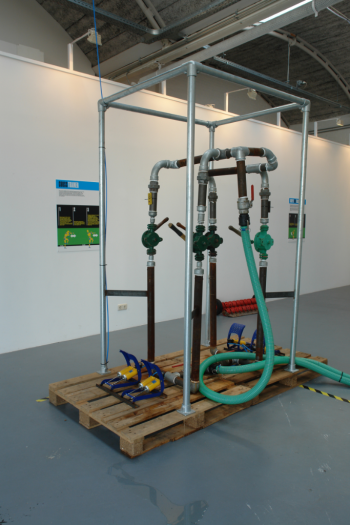
The arms push the levers forward and backward. This movement pumps water into the pressure vessel. The legs are moved up and down as if walking up the stairs. This movement is pumping air into the pressure vessel.
Arms and legs are moving at the same time, somewhat similar to the movements during cross-country skiing. Two people can operate the machine while looking at each other, which creates an intimate atmosphere. The machine makes a lot of noise.
3. Biceps and Triceps Extension
This exercise machine, which produces compressed air, can be operated by four people simultaneously.
One person operates the foot pedals, which work similar to the foot pedals of the Cross Trainer that we described above. Two persons train their biceps and triceps by moving the handles on each side up and down.
A fourth person turns the wooden wheel that operates an air compressor. The latter produces delicious farting sounds and is very popular with children and adults who refuse to grow up.
The manually operated air compressor is surprisingly effective. We aim to improve it further by adding a better flywheel that is turned by a smaller hand cranked wheel.
4. Heavy Pull Drag
The Heavy Pull Drag produces a large amount of power in a short time. The machine is inspired by human drawn canal boats from earlier times. As an exercise device, it appeared in the 1990s, aimed at American football players.
To produce power, the operator puts on a harness with a cable attached to it. The cable is wound around an old car rim, which is fixed to a powerful membrane pump.

The operator walks forward or backward while wearing the harness, keeping his/her body as low to the ground as possible. Walking forward trains the muscles in the back, walking backward trains the quadriceps in the legs, and pulling sidewards trains the muscles of the hip.
The Heavy Pull Drag is our most powerful water pump. Although it works very well, it needs some further improvements. The most important one is a mechanism that rolls the cable in automatically.
Human Power Plant 1.2: Work Songs
Video of the prototype in Antwerp. Made by Laura Zuallaert.
In order to try and motivate people to generate their own power, we have equipped the second version of our human power plant with sound production.
In earlier times, when physical labour was much more common than it is today in the industrialised world, people sang songs to increase work productivity, keep boredom at bay, or coordinate the actions of different workers. At the same time, these work songs were an outlet for humour, ridicule, and frustration.
Following the same logic, in the Human Power Plant every movement that produces energy now also produces sound. Consequently, each time the Human Power Plant is operated, a work song is composed.
The Human Power Plant 1.2 was built in Antwerp, Belgium, where it was shown during a preview on October 8, 2017. Archipel, the makers collective that offered us the space, brought a team of unsuspecting bodybuilders to the event and made a video, which you can see above.
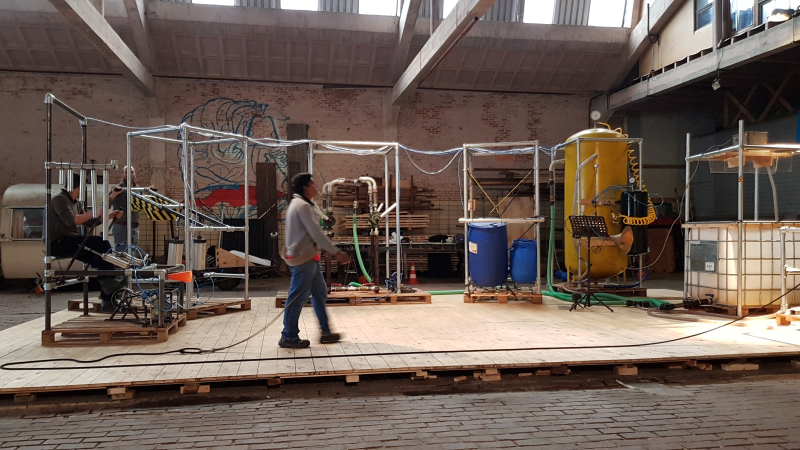
Prototype in Antwerp. Picture: Alies Broekhuizen.
From October 14, 2017 to January 15, 2018, the Human Power Plant can be seen, touched and operated at the Museum Boijmans van Beuningen in Rotterdam. It will power the Christmas tree of the museum, provided that visitors are prepared to exercise
The Boijmans Museum made a video of us while we were building the Human Power Plant in Antwerp, which you can see below.
During the first month in Rotterdam, sound production has already proven to be a very effective motivator of human power, even without a tree to light up. In fact, the human power plant has become the victim of its own success, needing daily repair to keep it in operation.
In comparison with our previous prototype, which tried to lure people with a jacuzzi, it is clear that sound attracts more energy producers and keeps them exercising for longer.
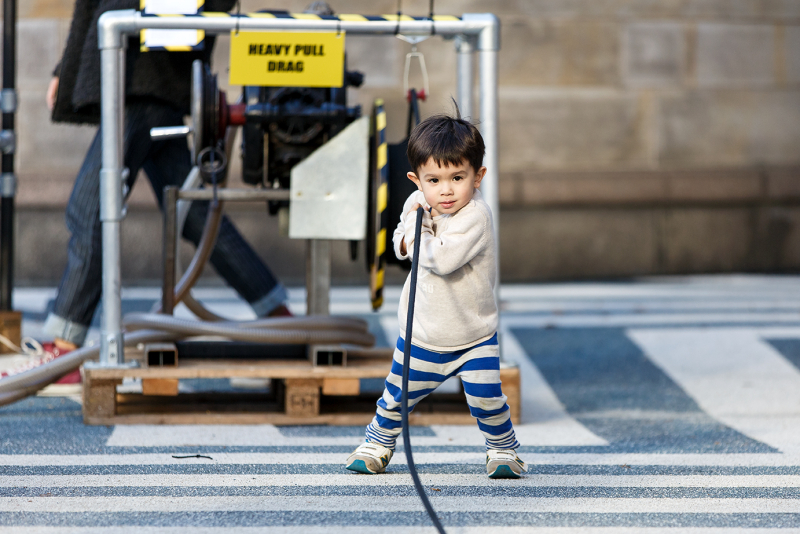
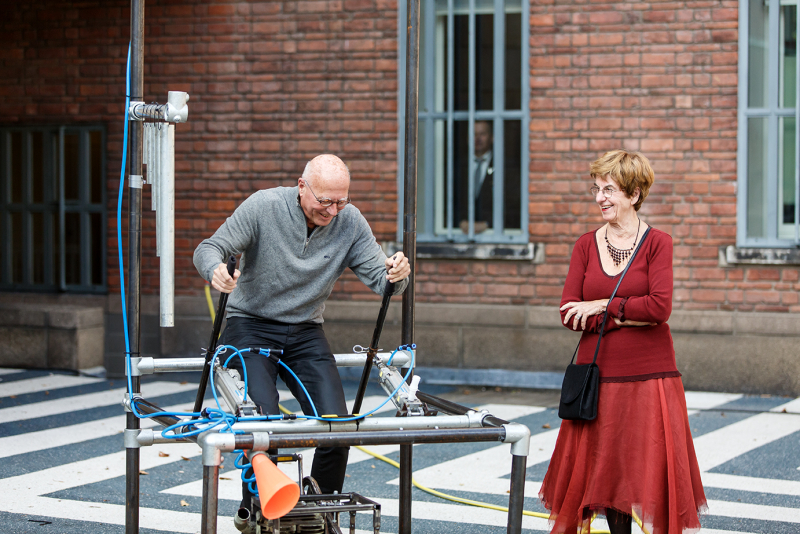
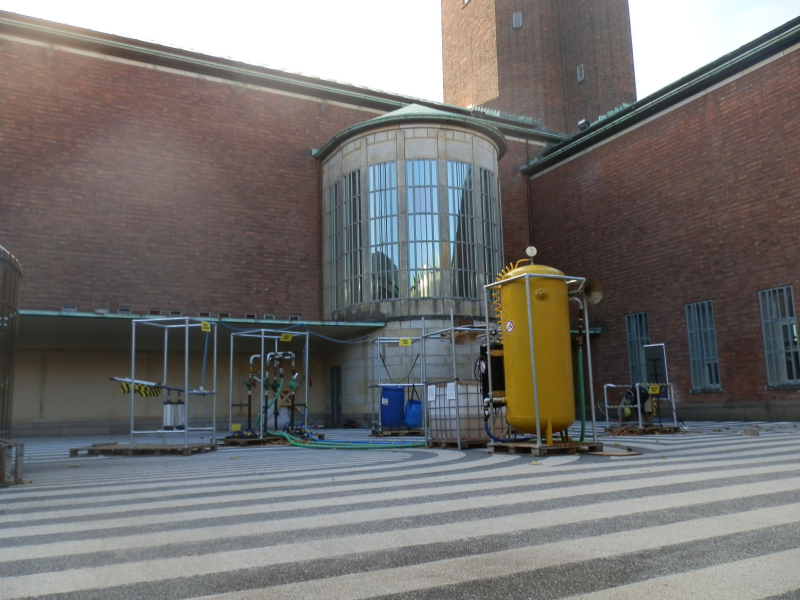
The Human Power Plant in Museum Boijmans, Rotterdam. Pictures: Aad Hoogendoorn.
How Much Energy Does it Produce?
Some people have asked us how much energy the human power plant produces. The answer is: not much. This prototype was built to investigate whether or not people can be motivated to produce their own power, and do this in the most sustainable way (no chemical batteries, no high-tech components).
To achieve this, we built a very energy inefficient power plant. Everything that makes it fun, also makes it inefficient. Take another look at the scheme below. Mechanical movement is converted to water under pressure and compressed air, which are then converted to electricity.
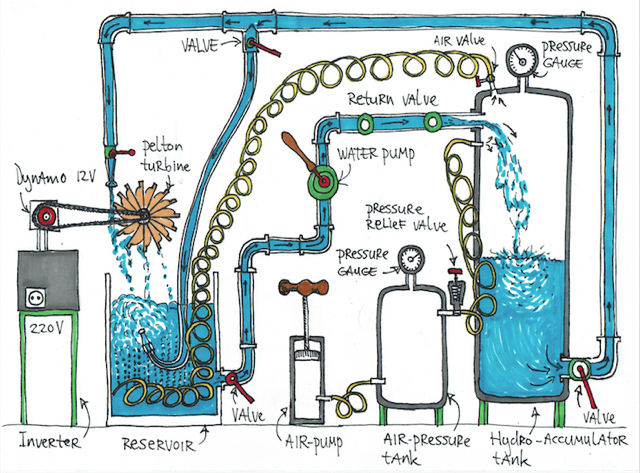
There are so many conversion and distribution losses in the process that it’s actually surprising that the human power plant still generates electricity at all — an estimated 60 watts of power when all six exercise machines are used simultaneously. Assuming an average human power production of 100 watts, this corresponds to 10 watts of power per person, or an energy loss of 90%.
Could it be that efficiency is simply not fun? Or could we make a human power plant that is both energy efficient and fun to use? That´s the challenge for the next prototype.
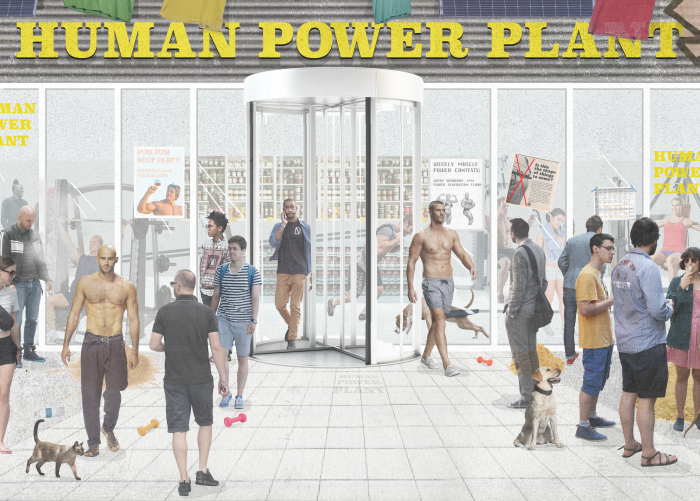
This scenario describes the conversion of a 22-floor building into an entirely human powered student community. The plan is based on the Willem C. Van Unnik tower, the tallest building on the campus of Utrecht University in the Netherlands.
The concrete, steel and glass monolith, which occupies a central position on the campus, was built in the late 1960s and has been mostly empty for years. We propose to turn a problem into a solution, especially since the university wants to be carbon neutral by 2030.
Health and Fitness
A human powered student community has potential for a reduction in energy use. If students have to generate their own power, they are much less likely to waste it. Energy use is also lowered by the communal organisation of daily household tasks, just like in the old days.
Finally, the human powered student community applies high-tech and low-tech to increase efficiency, such as led-lights, fireless cookers, thermal underclothing, and heat exchange showers — which all maximize comfort in the context of a limited energy supply.
The Human Powered student community is not only 100% sustainable, it also promotes better health and fitness, and more social cohesion.
Each student generates the electricity that’s used in his or her own room. Research has shown that students are most attached to their phone, their laptop, and their lighting. The operational electricity use of these modern technologies is relatively low. The students will be generating energy for only 1 to 2 hours a day in order to use their most cherished devices.
Each room is equipped with a box-bed, which provides heat insulation during the night. The rest of the room can be warmed by the body heat coming from the lower communal power generating floors. By opening the vents of the heat distribution pipe, students can release the warm air into the room. For extremely cold days, students can plug a body suit into the vents, which results in a direct heating of the body. Read more.

Moving Between Floors: The Stairs.
The human powered student building has 22 floors and no passenger elevators. In many tower buildings, the stairs get rarely any use. In the human powered student tower, they are teeming with life. Climbing the building at an easy pace, one step at a time, requires roughly 30 seconds per floor. If this speed can be sustained until the top floor, climbing the whole building would take 11 minutes.
Running instead of walking up the stairs could greatly increase travel speed. The best athletes in the yearly Empire State Building Run climb 86 floors in 10 to 12 minutes. At such speeds, it would take only 3 minutes to climb the entire human powered student building — quicker than an elevator, which usually stops along the way. Going down the stairs would go even faster when jumping and swinging around corners. Read more.

Communal Shower & Laundry Floors.
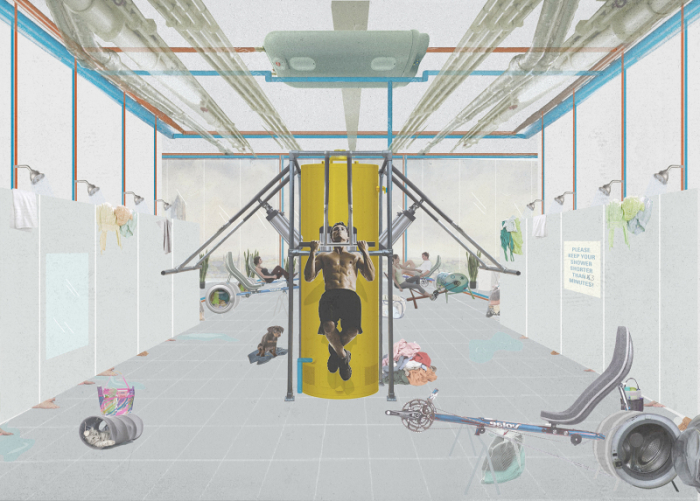
Providing 750 students with one 7-minute hot shower per day would require a workforce of 750 students generating power for 10 hours per day. In other words, the complete student population would be working all day to provide everyone with a hot shower. This makes no sense. Therefore, students only take a 1-minute hot shower every day, or a 3-minute shower every three days, and so on. In between, they can do quick washes at the sink, or to take cold showers.
Energy use for doing the laundry is reduced significantly by washing clothes in cold water; Between 80 and 90% of the energy use of a washing machine is used to heat the water. In recent years, manufacturers have found ways to create detergents that work very well in cold water. Furthermore, the students are advised to wear woolen clothing, which needs to be washed less often and preferably in cold water. Read more.
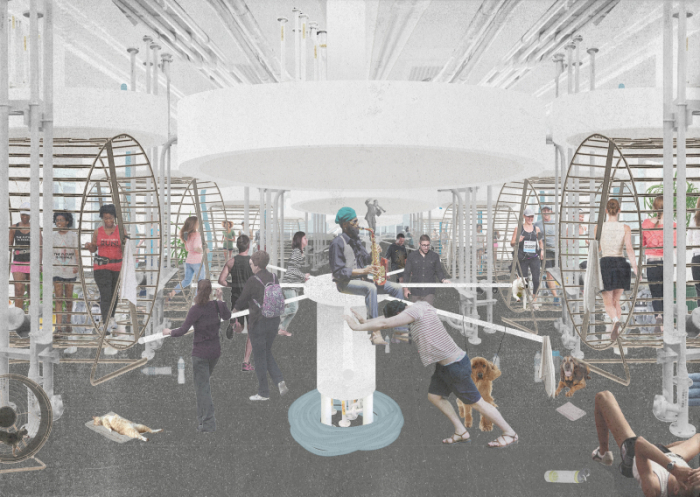
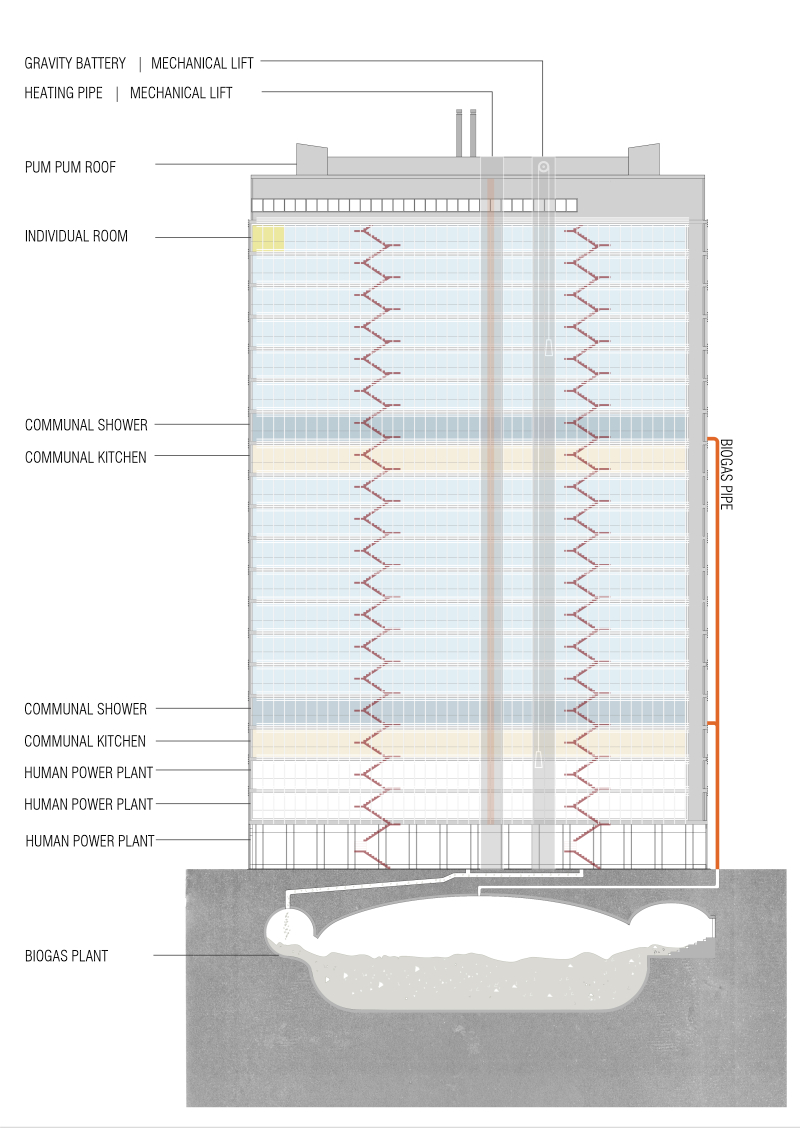
Three floors of the human powered student building are taken up by the central human power plant, which is run by the entire community. The energy that’s produced here is used to warm the water, run the refrigerators, flush the toilets, and power the lights and other devices in the communal spaces. The body heat from the power producing students is piped throughout the building and into communal spaces and individual student rooms.
The power generation floors are equipped with various individual and communal exercise machines. Most power is produced by large treadmills and capstans, which are each operated by up to a dozen people at the same time. The power producing students are encouraged by live musicians. The use of music during physical labour — to pass the time, to coordinate timing, or to protest against work conditions — has a very long tradition. Read more.
The food waste from the kitchen and the excrements of 750 students are used to produce biogas that supplies the energy for cooking. On the other hand, energy use for cooking is reduced substantially by communal food preparation and the use of fireless cookers. After food is brought to a boil on a biogas fire, cooking pots are placed in a heavy insulated container, which keeps the cooking process going without the need for additional energy.
The use of excrements for biogas production requires the installation of vacuum toilets. These toilets separate the solid waste from the urine and transport it to the biogas installation in the basement with the use of very little water. Operating a biogas digester is labour-intensive: food waste needs to be collected, and all biodegradable material needs to be mixed with water, fed in the digester, and stirred. Read more.

How to Feed a Human Powered Building?
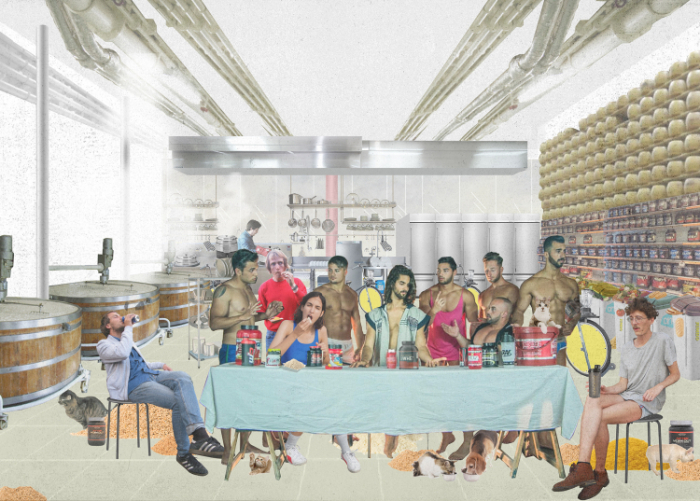
Humans need extra food when they produce power, and producing this food also requires energy. Assuming a typical Dutch diet, one kilowatt-hour of human generated electricity produces up to 30 times more greenhouse gases than one kilowatt-hour of grid electricity. However, the average Dutch person eats too much and could produce power for 2 to 3 hours without extra food intake.
To further limit the CO2-emissions of food, the students have opted to produce their own cheese and use the waste product of that process to make protein shakes. These are convenient because they allow active people to ingest sufficient proteins without grilling steaks and steaming vegetables almost continuously. To add surprises to the diet, students on cooking duty go dumpster diving in the city, mainly at the big supermarkets. Read more.
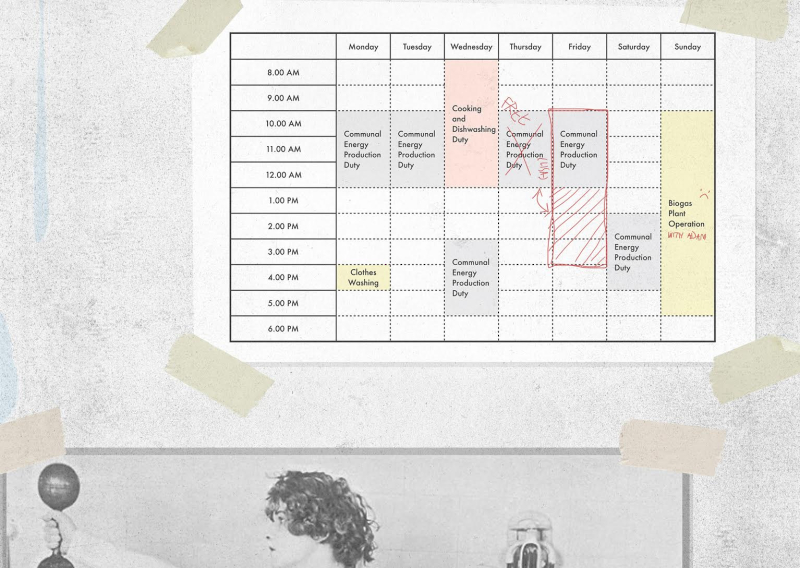
Daily Power Production: Work Schedules.
How long the students need to exercise depends only on their demand for power. Because the users of energy are also the producers of energy, there’s a strong incentive to reduce energy demand. The working schedules for communal energy production are negotiated and set up by the students themselves, who are in total control of their human powered community. The energy use in the individual rooms is decided by each student separately.
The Human Powered Student Building is equipped with a gravity battery in one of the former elevator shafts. It smooths out peak energy demand, which allows to spread the power generating workforce more evenly throughout the day. The energy storage also makes it possible to produce energy only during the day and still have power at night, for example to operate the refrigerators. Read more.
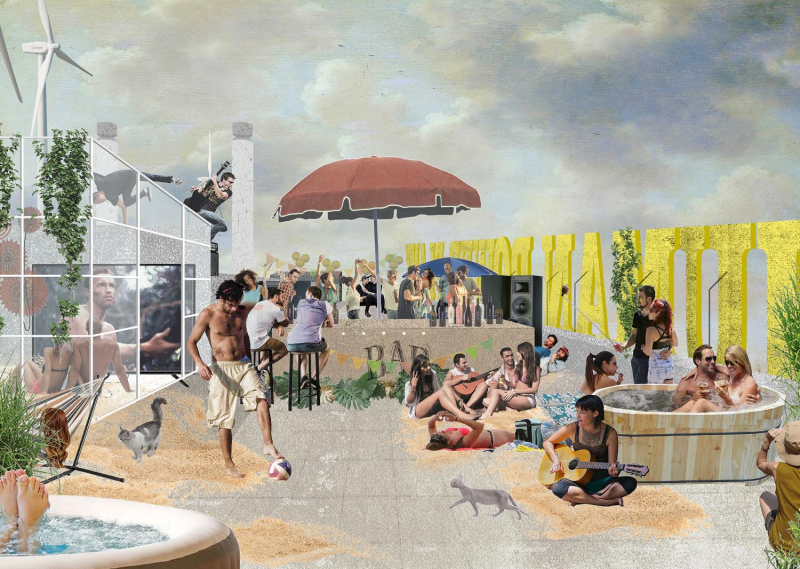
Sustainable Decadence on the Roof
Located on the roof of the Human Powered Student Building are ten Skystream windturbines. Together, these can supply 20 kW of power with a strong breeze (11 m/s). Whenever it’s windy, human energy production is taken over by the wind turbines. During windy periods, students thus enjoy free and effortless energy use. Daily working duties are reduced or eliminated.
If the wind blows long and hard enough, and the maximum capacity of the hydraulic power storage is reached, the student building has an oversupply of energy. This excess energy is used to have fun on the roof, which has jacuzzis, large screen televisions, powerful game computers, and a sound system. During windy periods, students head for the roof to enjoy sustainable decadence.

The Human Power Plant is an artistic research project into the possibilities of human power production in a modern society. Unlike solar and wind energy, human power is always available, no matter the season or time of day. Unlike solar panels, wind turbines, and batteries, humans don’t need to be manufactured in a factory. Unlike all other power sources, human power increases as the human population grows.
Concept Human Power Plant:
Kris De Decker & Melle Smets
Construction prototype HPP:
Planemos
Work Songs:
Mark Thur
Artists impressions HPP:
Golnar Abbasi
Arvand Pourabbasi
Pietro Degli Esposti
Melle Smets
Text:
Kris De Decker
Advice:
Jos van Gemert
Pim Rooymans
Franklin van Doesburg & Robin Bhaggan
Mark Thur
Dirk Wijnalda
David White
Bram Rombouts
Partners:
Go APE! – Art Park of Energy
ISA bewegingsanalyse
Jeu de Paume
Archipel / Rooftoptiger
Low Tech Magazine
Sportcentrum Olympus
Stichting Science Park
Instrumentatie Beta (Universiteit Utrecht)
Institute Engineering & Design (Hogeschool Utrecht)
Gemeente Utrecht
HU Digitale Media & Communicatie en Communicatie & Multimedia Design (Hoge School Utrecht )
HU Faculteit Natuur en Techniek
Commissioned by:
Department of Search
Contact:
Melle [at] departmentofsearch [dot] nl
Kris [at] lowtechmagazine [dot] com

The Willem C. Van Unnik building is the tallest building on the campus of Utrecht University in the Netherlands. The concrete, steel and glass monolith, which occupies a central position on the campus, was built in the late 1960s and has been mostly empty for the last 15 years. Maintaining it is an important cost for the university, who owns the building.
The Human Power Plant proposes to turn a problem into an opportunity by converting the building into student housing that runs entirely on human power. The University of Utrecht has the ambition to become CO2-neutral in 2030. The ecological footprint of the human powered Van Unnik Student Dorm will be close to zero, and the building is already there.

Painting: The slave market, Gustave Boulanger, 1882.
Unlike solar and wind energy, human power is always available. However, unlike a windmill, a solar panel or an oil barrel, human power needs to be motivated in order to produce energy. If we make a switch to human power production, would everybody generate their own power for the sake of sustainability? Would people pay others to do it for them? Or, would they force others to do it for them?

 Human Power Plant