-
In late May we organised a manual dredging workshop in Drachten, the Netherlands. The aim was to calculate how many people would be needed to dredge out the province and the whole country by hand. Here are the results.
-
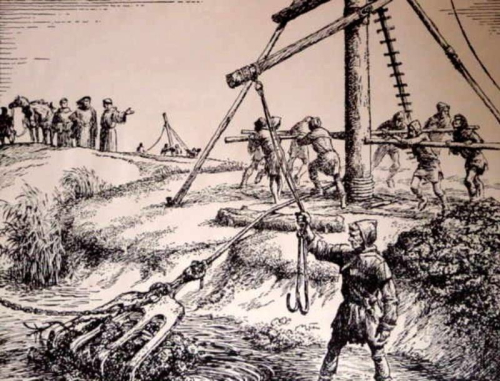
The dredging industry has been the backbone of the Dutch economy for centuries. If canals, harbours and rivers weren’t dredged out for a few years, the whole country would literally grind to a halt.
Today, dredging happens with oil powered ships. However, the Dutch waterways were dredged mostly by hand for centuries, using simple but ingenious tools. Could it be done again?
-
Are you in good shape and do you like to work in open air? Are you interested in cultural heritage and inspired to build a sustainable future? Then we need your help to create the first 21st century dredging colony in Friesland, the Netherlands. Join our workshop and you will never look at a watercourse in the same way.

The Human Power Project investigates the possibilities of human power production in a modern society. In our second case study, we turn towards a backbone of the Dutch economy: the dredging industry. Sustainability is all about cars and smart appliances, but what about large infrastructure and maintenance works? If canals and other waterways would not be dredged out for a few years, the whole economy would literally grind to a halt. However, modern dredging machines use enormous quantities of oil, which is not sustainable.
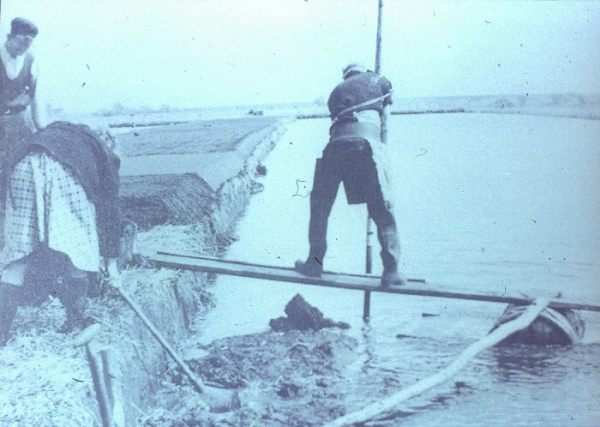
The Dutch waterways were dredged out by hand for centuries, using very simple tools. What if we would (need to) do that again? Human power is the most sustainable power source on Earth, but how many people would it take to maintain the waterways with human power alone? Where do we find those people? And could we design technology that improves the efficiency of human powered dredging operations? We are currently investigating these questions in Drachten, Friesland.

During the workshop on May 24, we will dredge out a natural harbour by hand, using old types of tools that we will build ourselves. The aim is to investigate which dredging techniques work best, and especially how much time it takes to clear a cubic metre of muck. With the data that we gather during the workshop, we can calculate how many people would be needed to dredge out the province and the whole country by human power alone.
When? May 24, 2018. You are welcome anytime from 10h to 17h. There will be food and drinks.
Where? Gaasterdjip Drachten, Friesland, the Netherlands. Follow the paved road to the head of the island, and then keep walking over the grass for another 100 metres.
Sign up: send a message to info@humanpowerplant.be under the mention of “baggerworkshop”.
-
The Human Power Plant is a multi-disciplinary research project into the possibility of sustainable energy production based on human power alone.
In a first case study, we designed plans for the conversion of a 22 floor tower building into an entirely human powered student community of 750 people, and built a working prototype of a human power plant.
In the coming months, we focus on two other concrete cases in the Netherlands, aiming to reveal what can be learned from a strictly human powered perspective.
-
- Sport für den täglichen Strom [Video]. ZDF, January 2018.
- Changemakers: Melle Smets & Kris De Decker [Video]. ART tube, December 2017.
- Energieopwekkende fitnessapparaten: waarom doet niet iedereen dat? Maakindustrie, November 2017.
- The great Human Power Plant experiment. Low Impact, October 2017.
- Maatschappij Hervorming, De Volkskrant, October 2017.
- L’énergie du futur passe-t-elle par les salles de fitness? Usbek & Rica, October 2017.
- Peut-on faire fonctionner une société moderne seulement avec l’énergie produite par la force de l’homme? Internet Actu, September 2017.
- Wonen op Menskracht. Engineersonline, July 2017.
- Alles over Energie, BNR radio duurzaam, July 2017.
- Spierkrachtcentrale maakt flatgebouw energieneutraal. Kennislink, June 2017.
- Menschenkraft statt Kohlekraft: Das innovative Human Power Plant in Utrecht. Agora42, June 2017.
- De toekomst van de ‘fun-slaaf’ [Video]. Eén Vandaag, June 2017.
- Student: energie zelf opwekken. De Telegraaf, June 2017.
- Feit of fictie: het Van Unnik als duurzame studentenflat. Dub, June 2017.
- Human Power Plant. Hacker News, May 2017.
- Totally Human Powered College Dorm, Green Wizards, May 2017.
- Dit flatgebouw van 22 verdiepingen draait helemaal op menskracht. EOS, May 2017.
- Could we run modern society on human power alone? Low-tech Magazine, May 2017.
- Futurs non conformes #3 Human Power Plant. Galerie nationale du Jeu de Paume Paris, May 2017
-
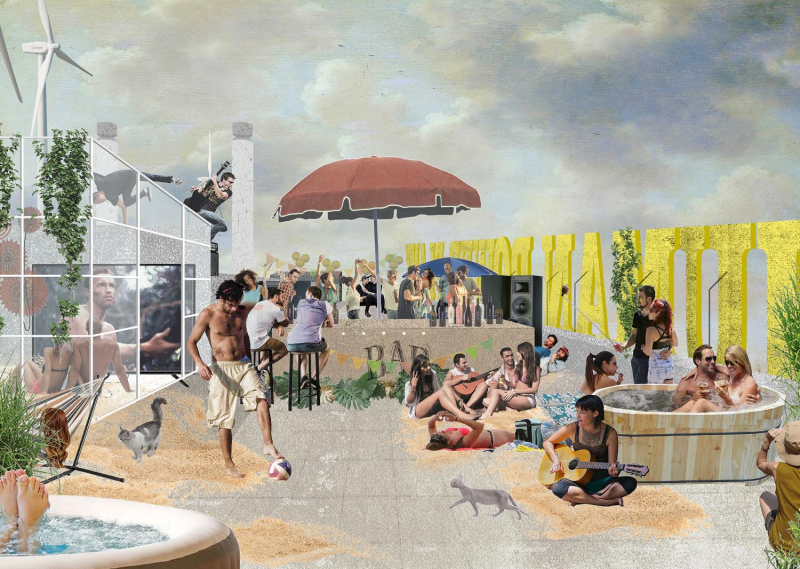
Located on the roof of the Human Powered Student building are ten Skystream windturbines. Together, these can supply 20 kW of power with a strong breeze (11 m/s).
Whenever it’s windy, human energy production is taken over by the wind turbines. During windy periods, students thus enjoy free and effortless energy use. Daily working duties are reduced or eliminated.
-
Video of the prototype in Antwerp. Made by Laura Zuallaert.
Everybody’s talking about sustainable energy, but what is it exactly? And how does it sound? We try to answer these questions with the newest version of our prototype Human Power Plant, an off-the-grid renewable energy source that produces electricity, compressed air, and water under pressure.
In order to try and motivate people to generate their own power, we have equipped the human power plant with sound production. In earlier times, when physical labour was much more common than it is today in the industrialised world, people sang songs to increase work productivity, keep boredom at bay, or coordinate the actions of different workers. At the same time, these work songs were an outlet for humour, ridicule, and frustration.
Following the same logic, in the Human Power Plant every movement that produces energy now also produces sound. Consequently, each time the Human Power Plant is operated, a work song is composed.
-
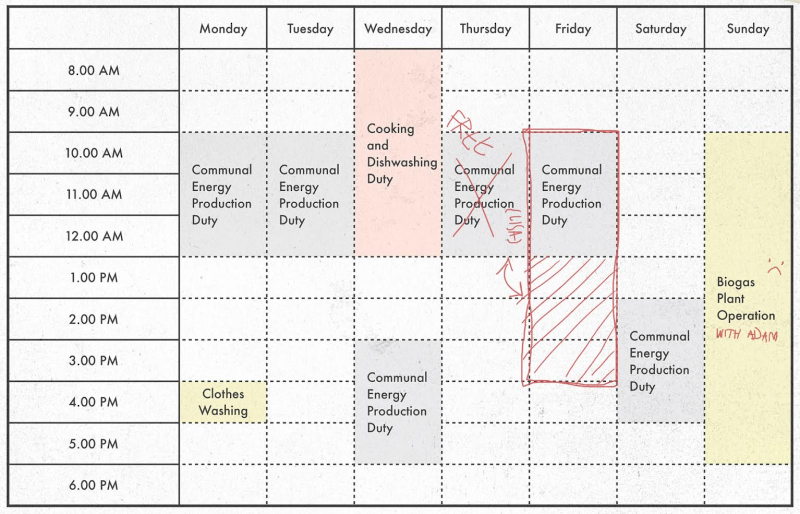
The lower floors of the human powered student building are reserved for communal energy production. How long the students need to exercise on these floors depends on their demand for power. Because the energy users are also the energy producers, there’s a strong incentive to reduce energy demand.
-
Subscribe
Subscribed
Already have a WordPress.com account? Log in now.
 Human Power Plant