
Dredging Colony Friesland re-introduces human power as an energy source in the Netherlands. Dredging by hand is sustainable and provides work for thousands of people, who all become an active part of the landscape.
For centuries, the Dutch have dredged their rivers, canals and harbours by hand. Today, only asylum seekers seem to be willing to carry out this work. Dredging Colony Friesland proposes a society model which reconciles sustainability and immigration.
Dredging 1 m3 of mud has a price tag of around 1 euro if the process is powered by fossil fuel powered machines. Because it takes roughly one hour to dredge 1 m3 of mud, manual dredging is not an economic model.
Alternative Economic Model
That’s why Dredging Colony Friesland assigns all dredgers a piece of land adjacent to the stretch of canal they have to maintain. They are allowed to build a house there, and live there with their families.
Human Powered Dredger
In the longer run, Dredging Colony Friesland evolves towards a co-operation. If dredgers join hands, they can maintain deeper canals, for example by using a human powered dredger. Deeper canals allow the local industries to expand. Meanwhile, the unique landscape will also give a boost to the local tourism industry.

Dredging Colony Friesland also offers an answer to the threat of climate change – especially relevant in a country that is largely below sea level. The new habitants use the scooped mud to raise the land on which they build their villages – an approach that is more than 2,000 years old.
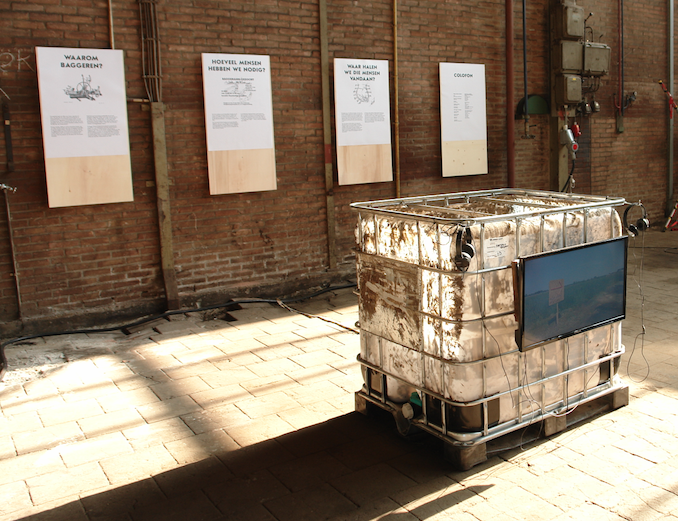
The exhibition “Dredging Colony Friesland” was presented at the “Sluisfabriek” in Drachten, Friesland. It resulted from a workshop manual dredging – in which we tried to figure out how long it would take to dredge the country by hand – and from historical research into Dutch dredging techniques. The prototype Human Power Plant was also part of the exhibition.
Colophon
Artistic team: Kris De Decker & Melle Smets
Models & Drawings: Melle Smets
Text: Kris De Decker
Photography: Philippa Driest
Reporter: Bram Esser
Graphic design: Golnar Abbasi
Participants dredging workshop: Erik Stoute, Hamad Abdulyahman, Serwan Khder , Oham Raad, Tijani Damilola, Younnouss.
Set production: Crijn Mandema
Curator team TAAK: Theo Tegelaers, Christiane Bosman, Charlotte Bijl
Funded by: Municipality Smallingenland
Partners Research Program: COA Drachten, Craftwurk Smelne’s erfskip, Maatschappelijke Onderneming Smallingerland, Leerbedrijf ROC Friese Poort
Special thanks to: Gea Smidt, Eduard de Ridder, Merit Prins, Klaas hendrik Rozendaal, Nicky Korte, Amanda v/d Veen, Tjerk Kwast, Trea Westra , Jan Zandberg , Rik van der Wijk, Roelof Hazelhoff
Exhibition & Presentations: Bestemming Drachten, Crossing Border Festival 2018, Border Labs, Enpuls
Location: Sluisfabriek Drachten
Period: May – September 2018
 Human Power Plant
Leave a comment