
Exercise machines for strength training can produce a lot of power in a very short time, making them an interesting addition to stationary cycling machines for human power generation.
***
During the research for the prototype human power plant, we tested the power potential of various exercise machines for strength training in a health club in the Netherlands. In the image above, these machines are positioned in the blue section of the health club’s floor plan.
We measured the distance travelled by the counterweight of each machine, and multiplied it by the amount of times that the weight was lifted for 1 minute (+/-15 times). The power potential in the stored weight is then calculated according to the formula 1kg x 9.81 m/s2 x 1m = … J = … W
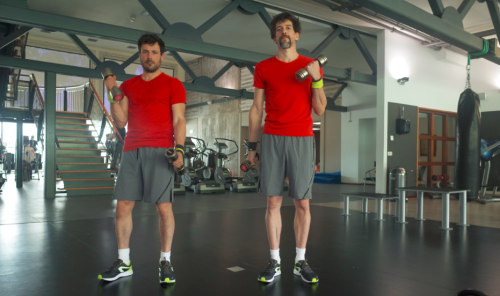
We show the power production for two human subjects. On the left, Melle (the powerhouse in our team), and on the right, Kris (who beats Melle with triceps and shoulder exercises).
POWER PRODUCTION
- Lat Pulldown: 594W/612W
- Leg press: 450W/360W
- Low Row: 306W/270W
- Chest Press: 270W/189W
- Machine Fly: 234W/189W
- Leg extension 207W/126W
- Triceps extension 198W/234W
- Shoulder press 135W/162W
These power rates are similar to or higher than those of intensive cycling for very short periods.
ENERGY PRODUCTION
- Lat Pulldown: 9,9Wh/10,2Wh
- Leg press: 7,5Wh/6Wh
- Low Row: 5,1Wh/4,5Wh
- Chest Press: 4,5Wh/3,15Wh
- Fly: 3,9Wh/3,15Wh
- Leg extension 3,45Wh/2,1Wh
- Triceps extension3,3Wh/3,9Wh
- Shoulder press 2,25Wh/2,7Wh
Assuming conversion losses of 30% in the generator, the electricity production for 1 minute is close to 7 Wh for the most energy efficient machine (lat pulldown). This is sufficient to light up a 5W USB desk lamp for more than one hour, or to operate a small computer tablet for two hours.
It would take 420W of solar PV panels and optimal solar conditions to generate as much electricity in one minute. The least efficient fitness machines still generate more than 2Wh electric power for a minute, equal to 120W of solar PV panels at peak output.
Strength exercises are usually done in three series with resting periods in between. A workout series on one of the more efficient of these machines thus supplies more than 15 Wh of electricity. That’s enough to charge a quarter of a laptop’s battery, or run the light for 3 hours.
ENDURANCE TRAINING
We also measured the power potential of various exercise machines for endurance training, which are located in the blue section of the health club’s floor plan above. These machines are used in a different way. Power production is lower, but the effort is maintained for a much longer time. We only have results for one person per machine.
- Stair stepper: 150 watt = 50 Wh in 20 minutes.
- Rowing machine: 122 watt = 40.6 Wh in 20 minutes.
- Cycling machine: 110 watt = 36.6 Wh in 20 minutes.
- Crossfit: 50 watt = 16,.7 Wh in 20 minutes.
- Steps: 35 watt = 11.7 Wh in 20 minutes.
Obviously, these exercise machines for endurance training could produce more power if they would be used intensively for a shorter time. However, the introduction of strength training exercise equipment brings diversity into human power generation, allowing people to choose which bodily advantages they gain from their efforts.


 Human Power Plant
Leave a comment